LOVID
LoVid Hugs on Tape (Shimmy), 2024,
installation view
CARLA GANNIS
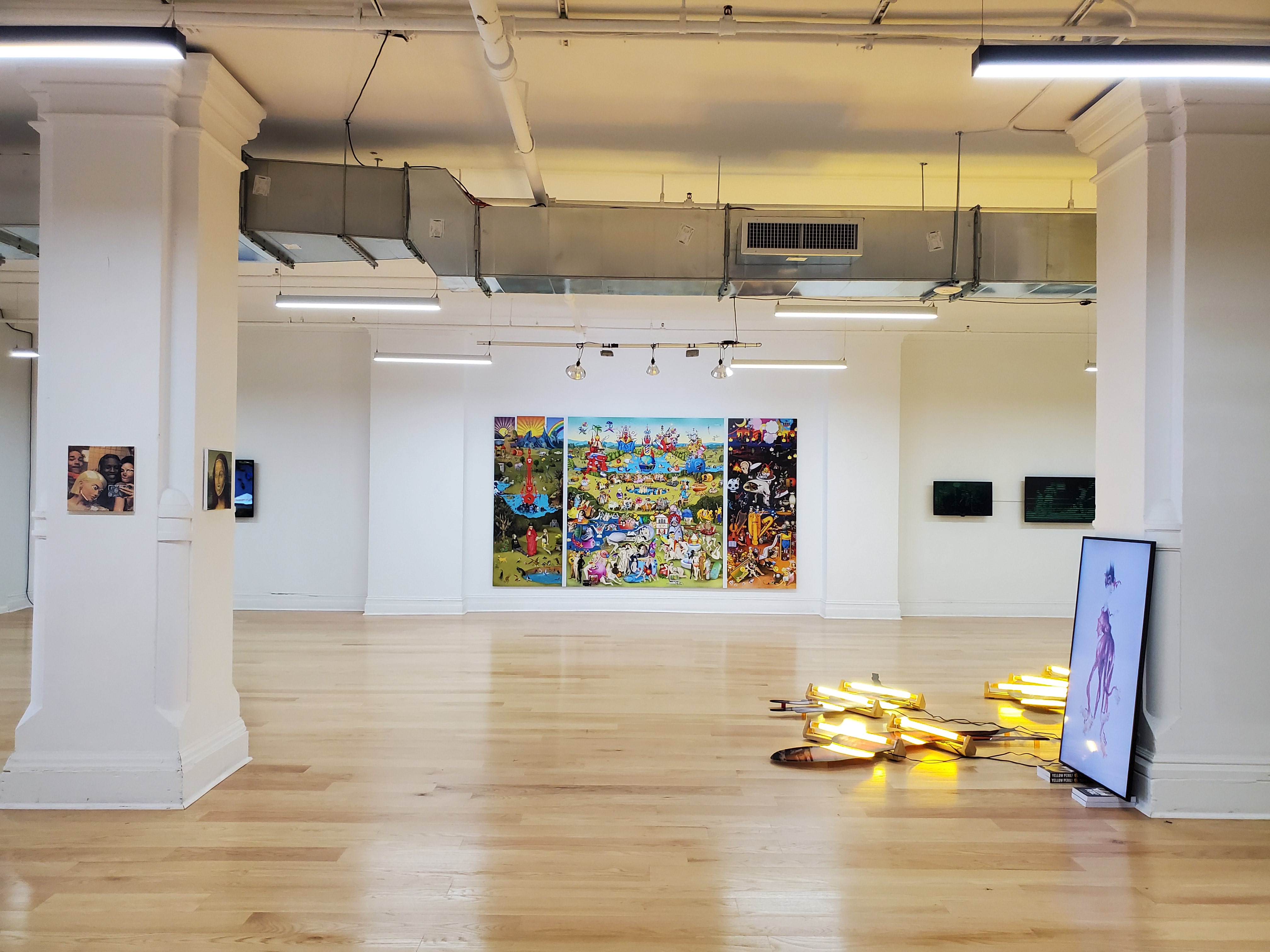
Carla Gannis 'Garden of Emoji Delights' (2014),
JENNIFER & KEVIN MCCOY
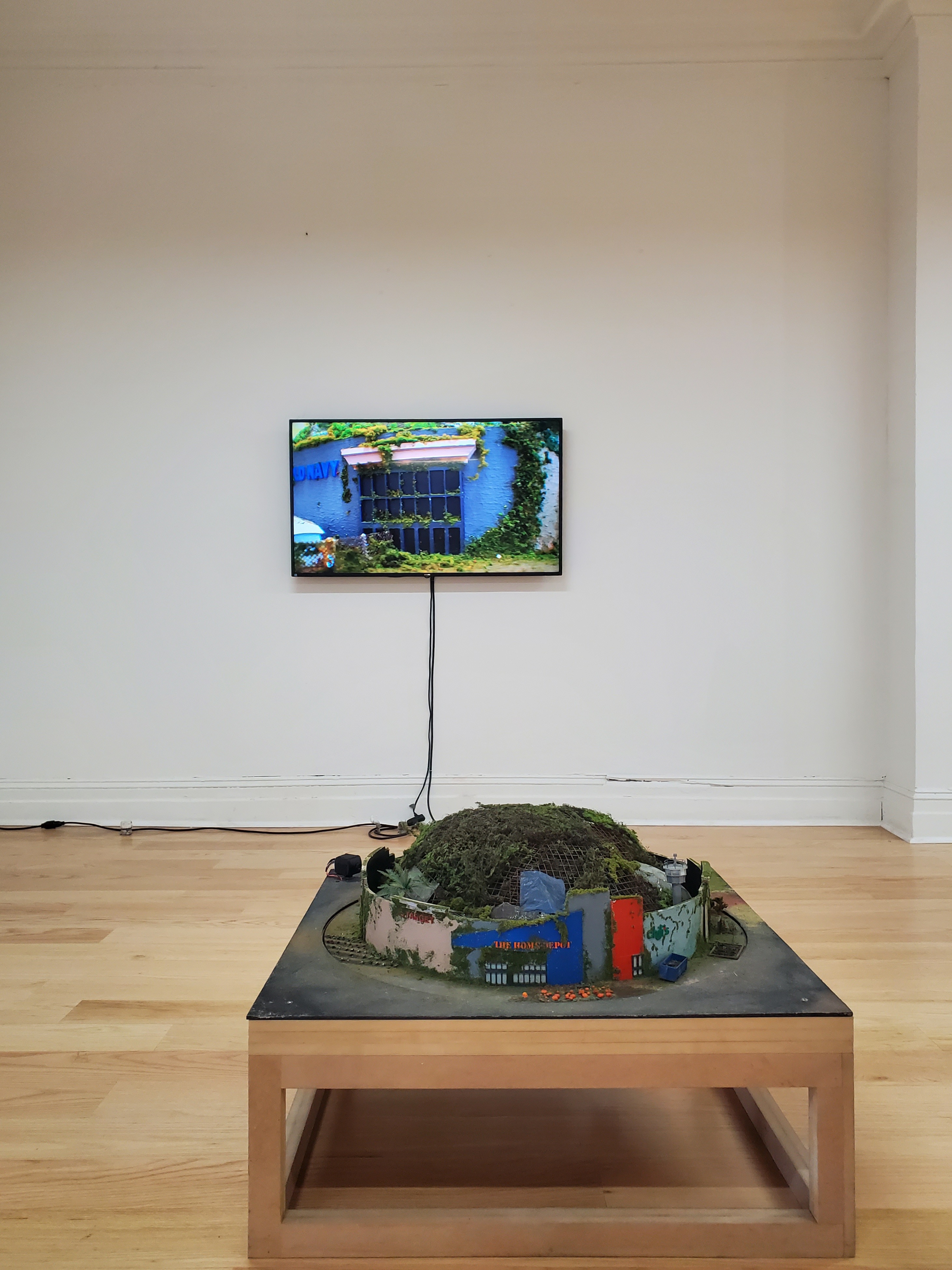
Jennifer & Kevin McCoy 'Big Box 3 (biosphere)' (2007),
installation view
VUK ĆOSIĆ
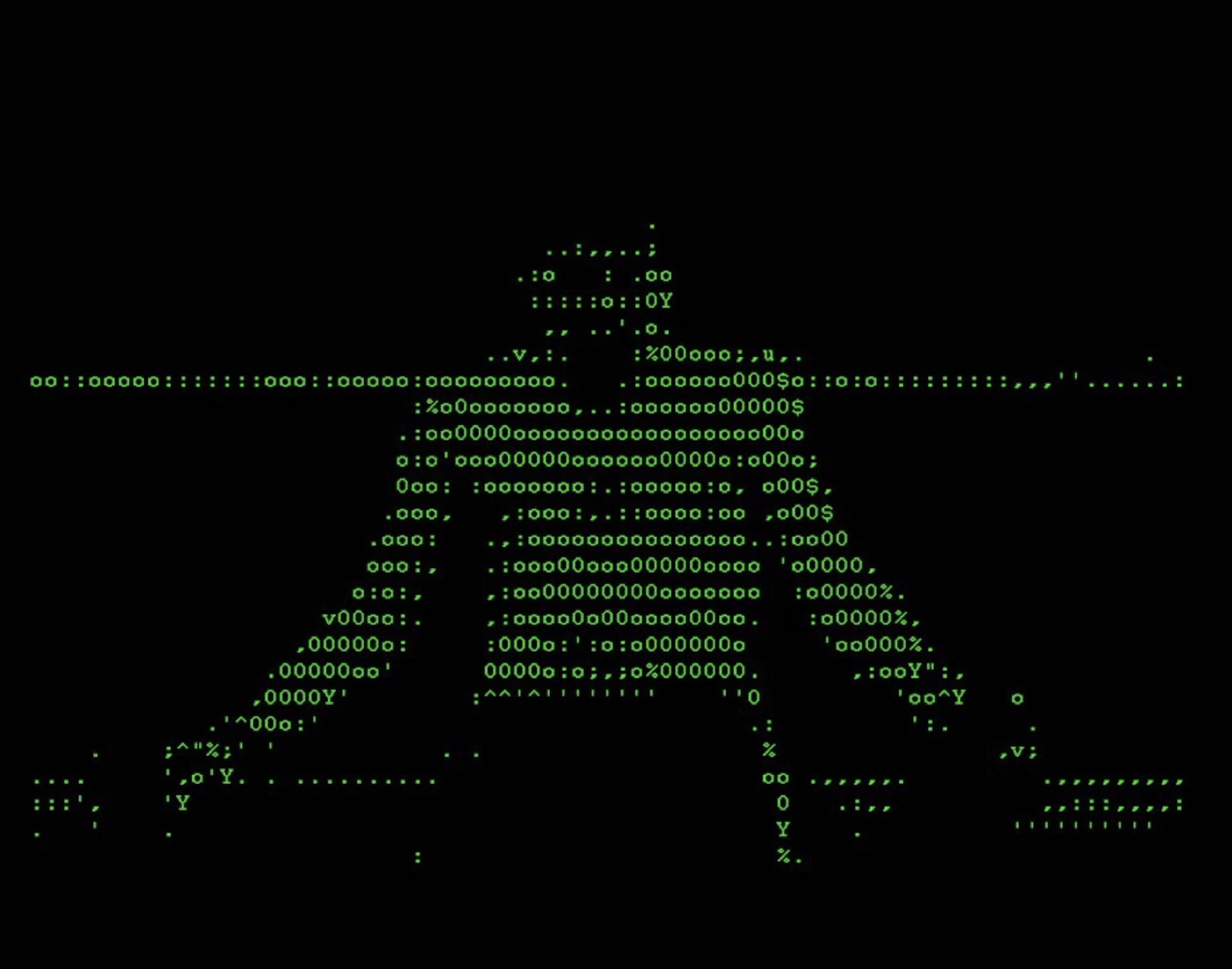
Vuk ĆOSIĆ, 'Raging Bull' (1999),
installation view
EVA PAPAMARGARITI
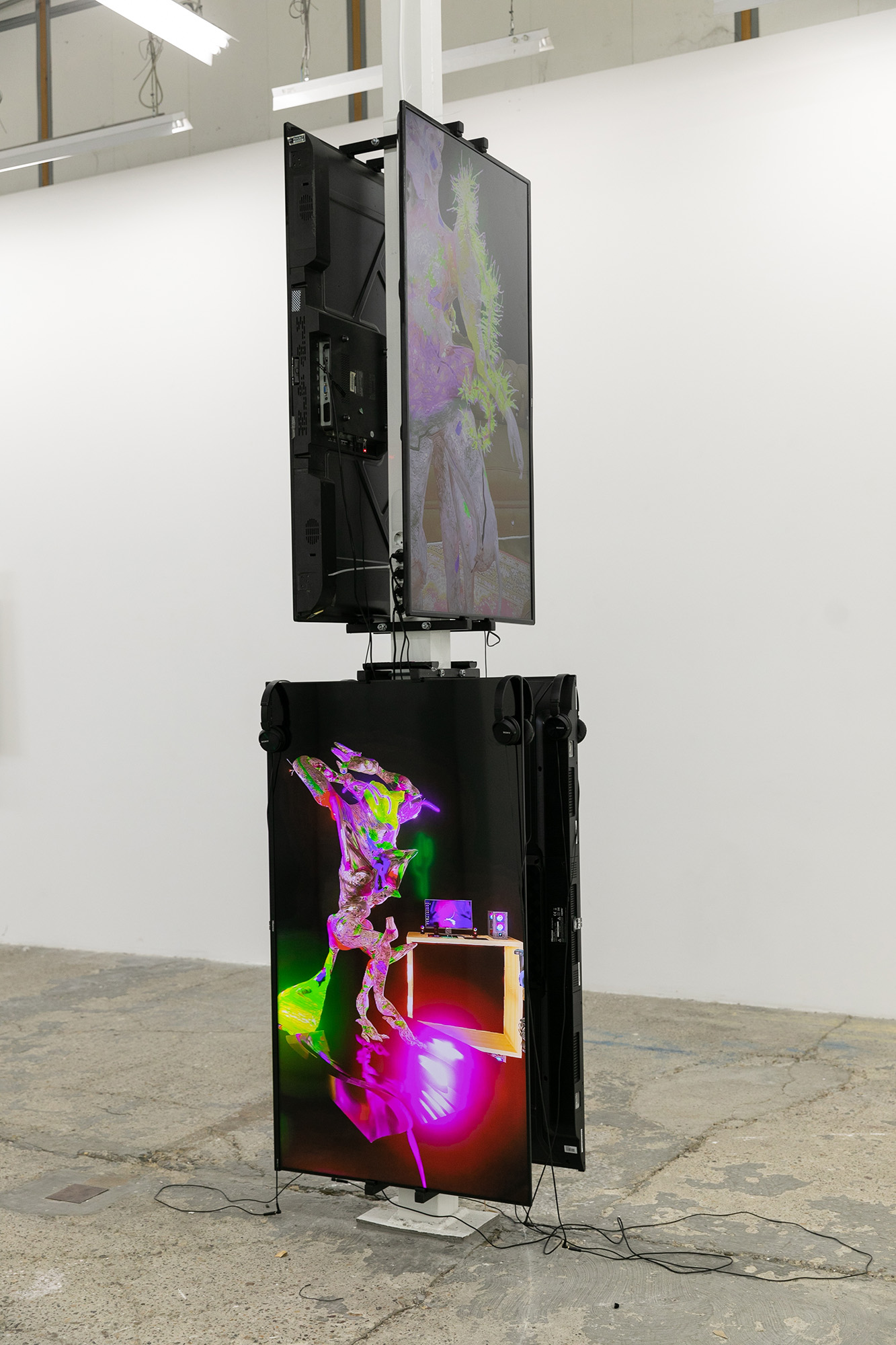
Eva Papamargariti 'Among Us, Among Others' (2023),
DAMJANSKI
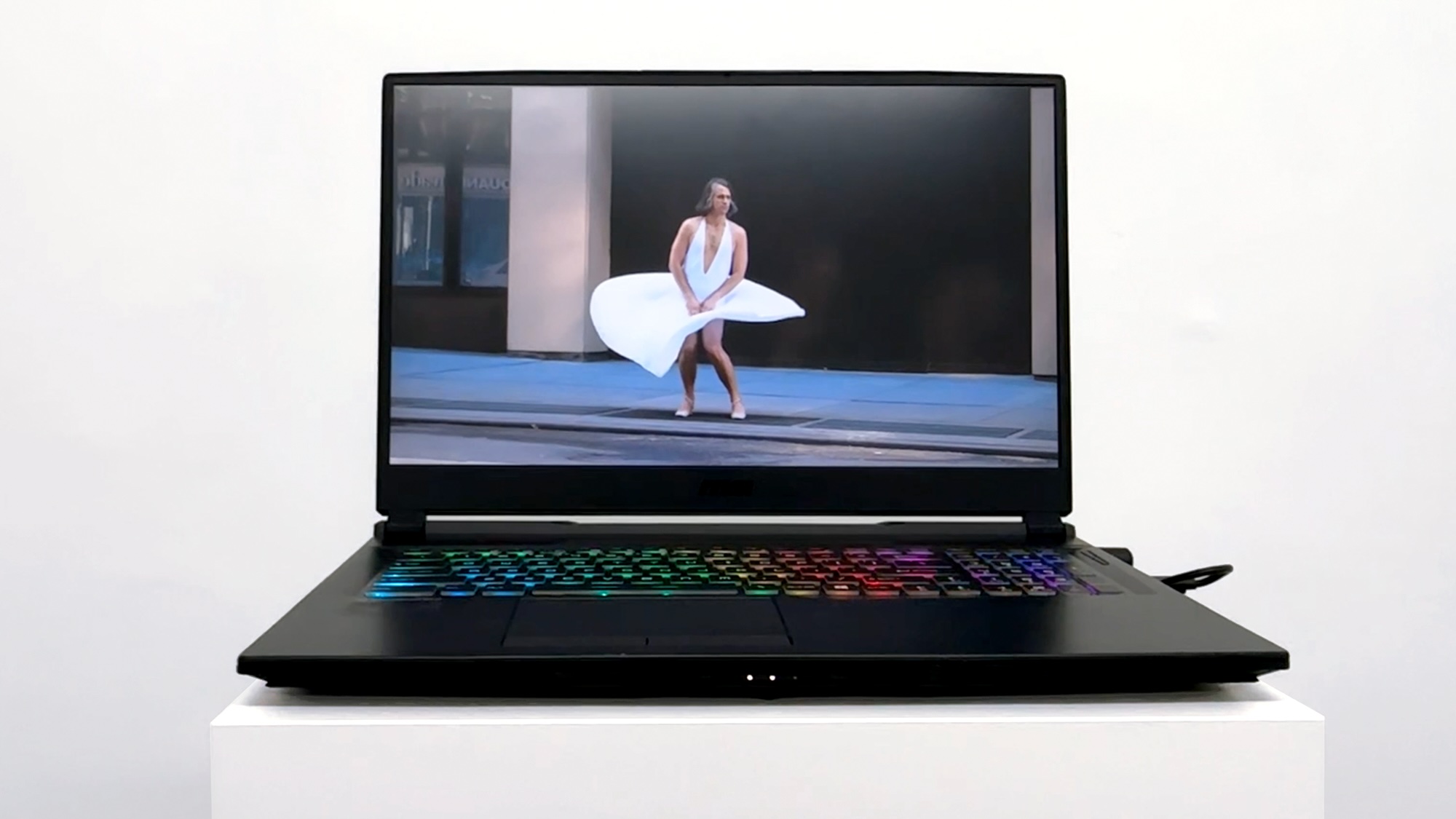
Damjanski 'The dress, the wind and me' (2024),
installation view
LORNA MILLS
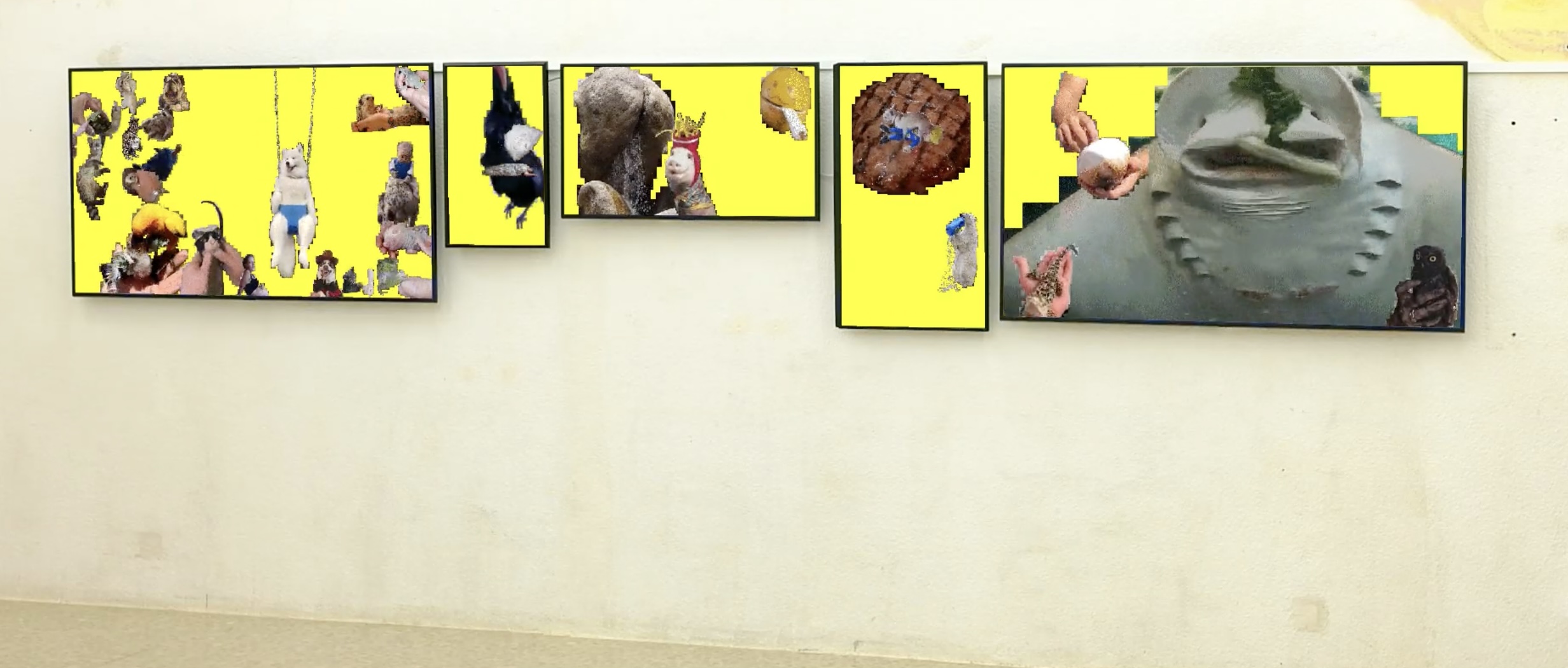
Lorna Mills 'Petting Zoo: Demons Begone' (2019),
installation view
ROSA MENKMAN
Rosa Menkman 'Xilitla' (2013),
installation view
installation view
MARTA KUCSORA
Marta Kucsora 'Beautiful Error' (2022)
FRANK WANG YEFENG
Frank Wang Yefeng's 'The Levitating Perils' (2024),
GRETCHEN ANDREW
Gretchen Andrew 'Famous Met Gala Selfie Facetune Portrait, 1' (2024),
HUNTREZZ JANOS
Huntrezz Janos 'Tinsel Polycarbonate' (2019),
POSTMASTERS GALLERY was founded by Magda Sawon and Tamás Banovich in New York's East Village in 1984. The gallery subsequently moved to Soho (1988), Chelsea (1998) and Tribeca (2013). In 2022 Postmasters entered a new nomadic model of a roving gallery.
ARAM BARTHOLL
Aram Bartholl 'Untitled 1' (2012)
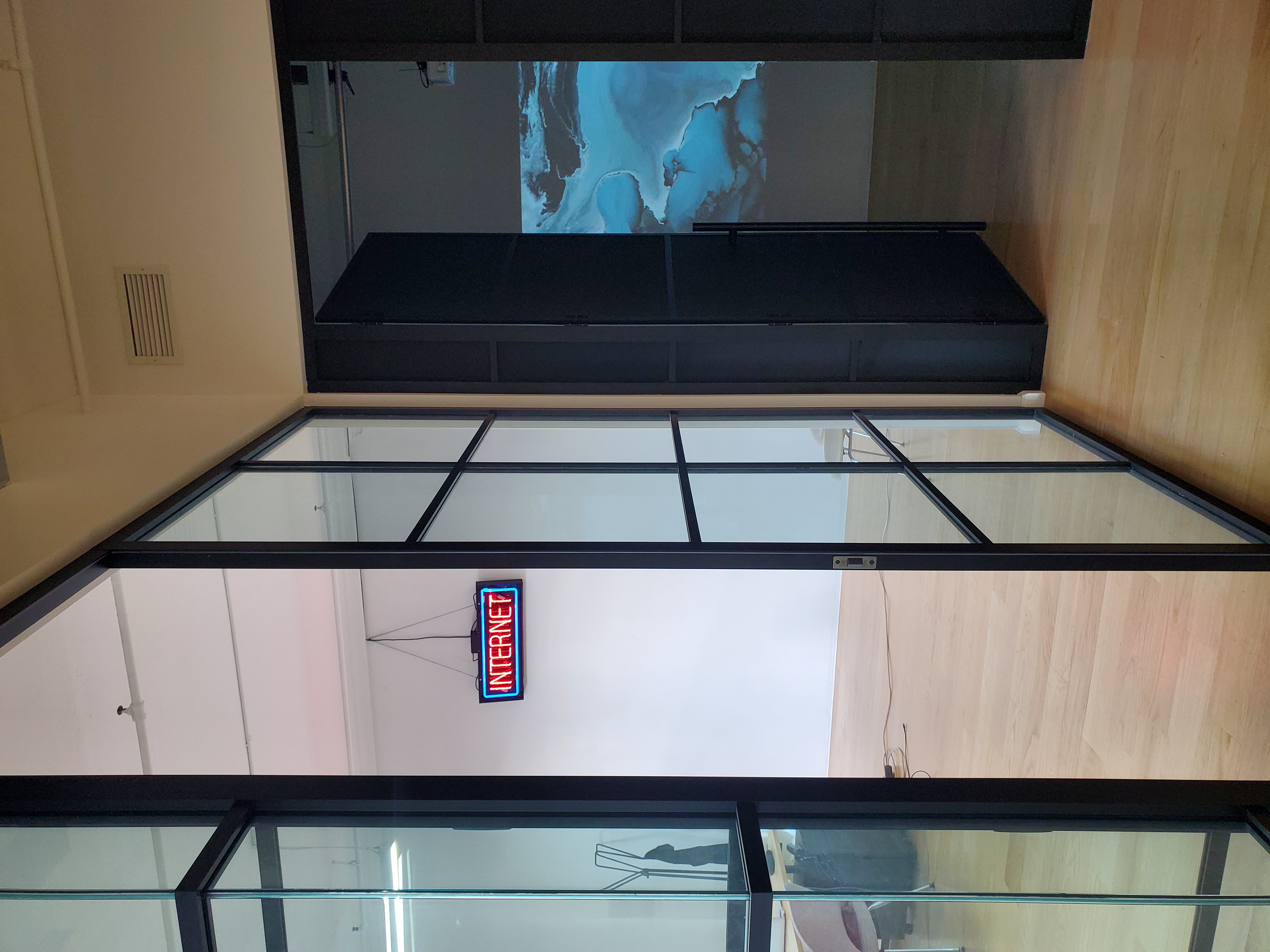
Postmasters 5.0 and TRANSFER
presents a collaborative exhibition
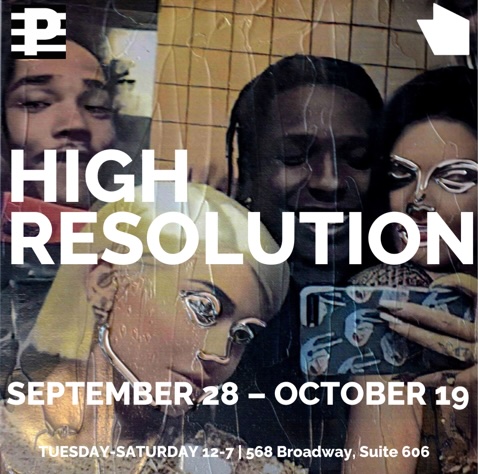
high resolution
GRETCHEN ANDREW - VUK ĆOSIĆ
DAMJANSKI -
CARLA GANNIS - HUNTREZZ JANOS
MARTA KUCSORA - LOVID
JENNIFER & KEVIN McCOY - ROSA MENKMAN
LORNA MILLS - EVA PAPAMARGARITI
FRANK WANG YEFENG
special appearance
ARAM BARTHOLL
location: 568 Broadway, suite 606, New York, NY 10012
September 28 - October 19, 2024
It's high time for High Resolution.
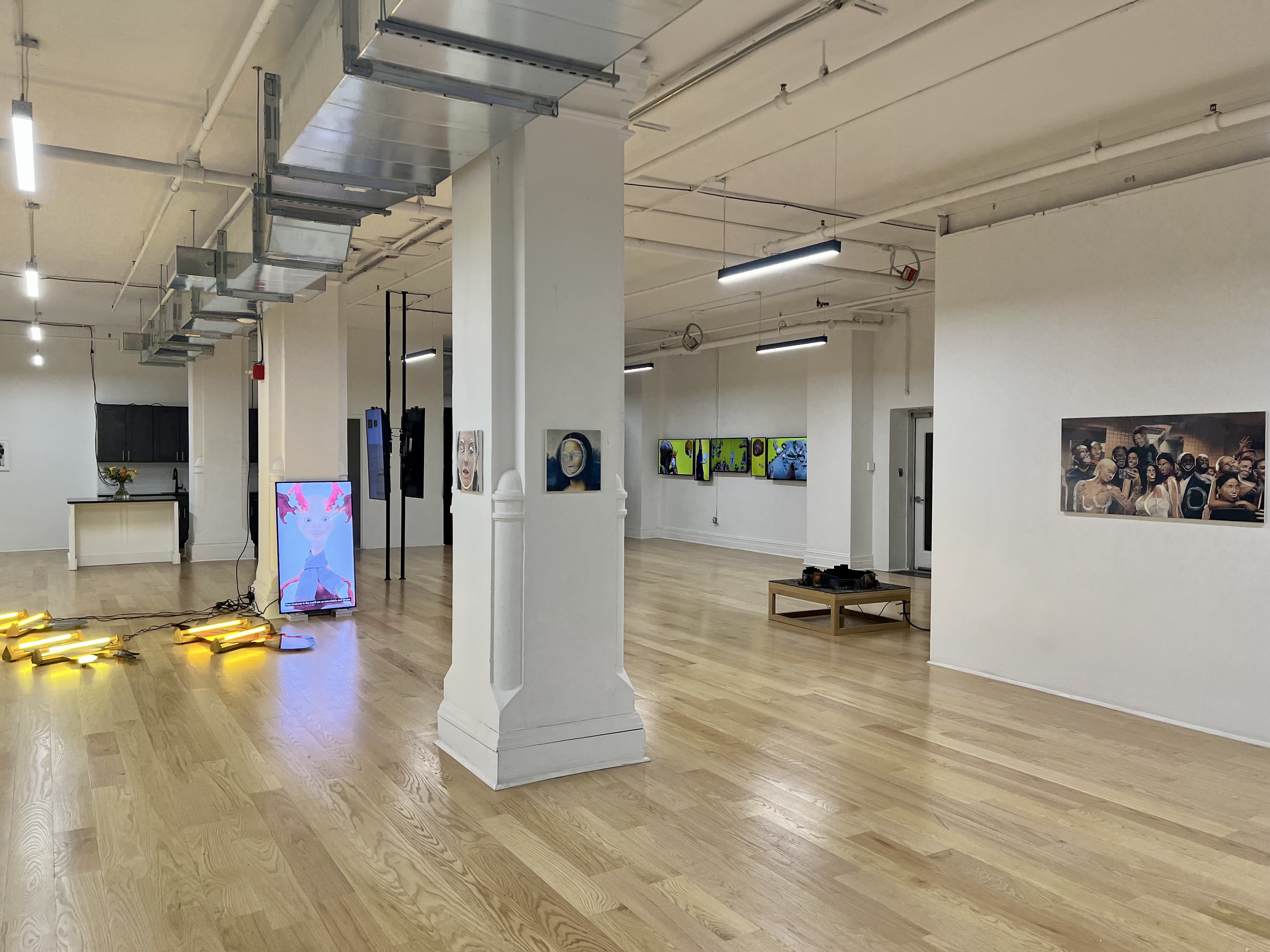
As the much needed antidote to a week of overwhelmingly static art at the fairs and the season opener shows, Postmasters 5.0 and TRANSFER will present a large-scale collaborative exhibition of digital art.
High Resolution will include several classics by pioneers of time-based media art shown along the hot-from-the-studio works by the new generation of digital artists. This high resolution, high energy, high bar exhibition will center around current ideas and technologies befitting 2024 and looking forward.
Tamas Banovich and Magda Sawon of Postmasters 5.0 and Kelani Nichole of TRANSFER are veterans who do not think like veterans.
.jpg)
digital animation / NFT, 3840 x 2160px, running time 00:14
Courtesy of the artist and Postmasters 5.0
LoVid is well known for recorded videos and live performances, where the audiovisual landscapes of moving image and sound are created through custom-built analog synthesizers. The hands-on process itself involves connecting lots of cables, twisting knobs, and flipping switches to make and mix RGB colors forming shapes, patterns, and rhythms. The imagery from the videos and performances is often transformed into digitally
produced fabric that comprises costumes, merch, installations, clothing, collages, and sculptures.
The series started in the dark depths of the pre-vaccine pandemic lockdown. Yearning to feel close to far away friends and family, LoVid asked them for short videos of hugs. These were then animated using raw video footage from over
20 years of LoVid recordings. "Dressing" their bodies in our video patterns showered these friends with love
since LoVid's video patterns are like raw emotions, non-verbal communication channels carried by electricity.
VideoWear was conceived as garb for a retro-futuristic universe where technology has developed as an
extension of organic systems. 14 LCD screens, interconnected by hundreds of feet of wire, are embedded in
protective sportswear and covered with sewn patchworks of video stills. Performing with the VideoWear the
artists became video marionettes. In their absence, the bodies annihilated, leaving behind avatars and puddles
of video signal. The VideoWear combines two aspects which characterize LoVid's production: hi-tech video and
sound experimentation and a bricolage, handmade aesthetic.
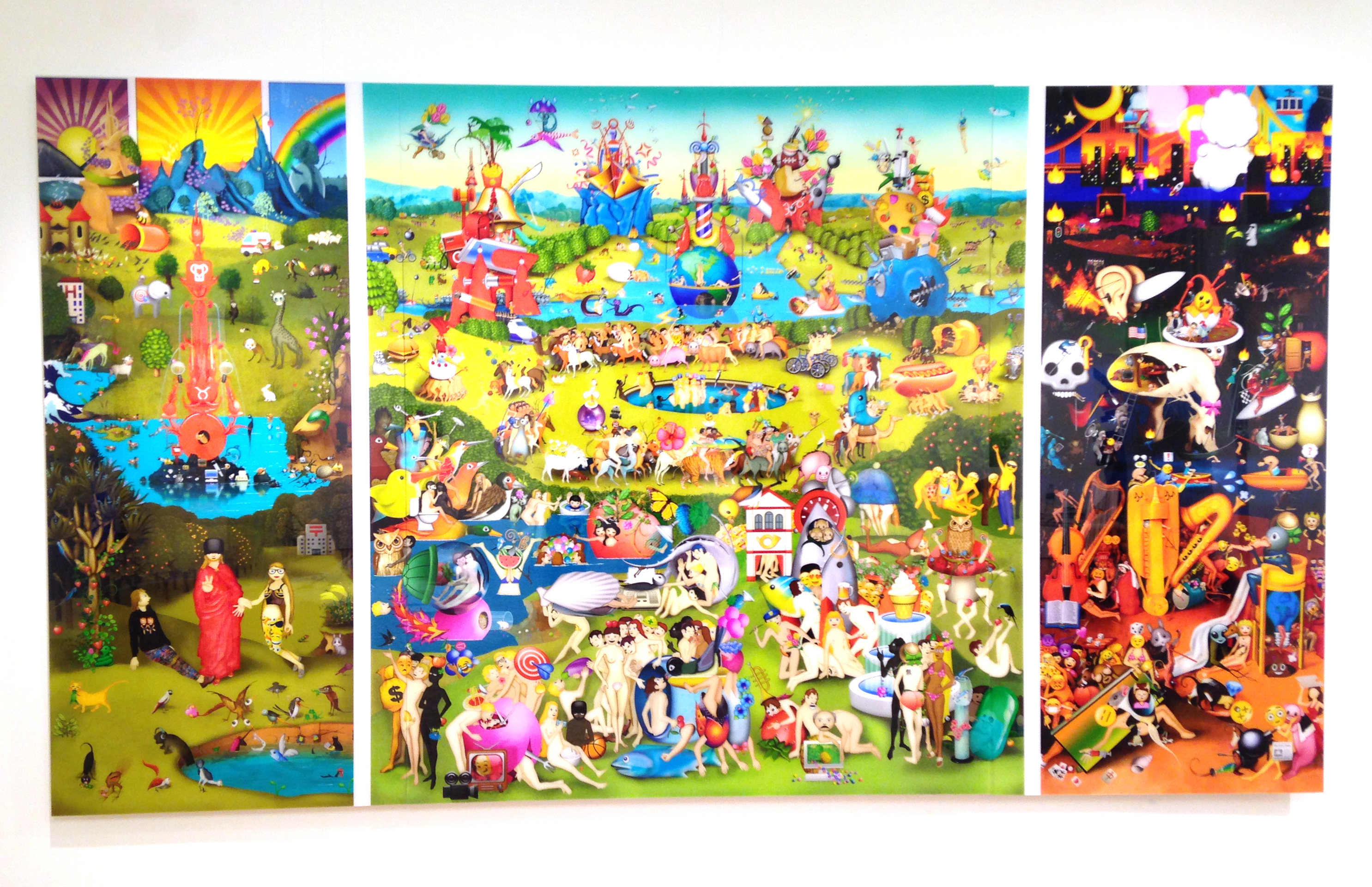
Digital Print 13' x 7'
Courtesy of the Fabric Media Collection and TRANSFER
Carla Gannis' "The Garden of Emoji Delights" is a full-scale in-visioning of Hieronymous Bosch's iconic altarpiece. Gannis re-inscribes the triptych by using the newsecular, pop vocabulary of signs and digital symbols, contextualizing Emoji within this iconographic lineage. These symbols are as pervasive now as religious symbology was in the 15th and 16th centuries. According to Carla Gannis, "Emoji add a new flatness
to the iconography of the past, emptying it of controversy and replacing it with something akin to Murakami's Superflat aesthetic questioning the "sins" of our contemporary consumer culture."
Gannis' digital altarpiece is a full-cale remake presented as an archival digital print on dibond with a semi gloss finish, mounted with steel bracing for easy hanging. Making for a striking piece, the work stretches 13 feet in length, only one edition remains available for collection.
Carla Gannis creates artwork with a commitment to experimentation. Throughout her career, she has worked with an array of mediums and tools, including drawing, painting, video, interactivity, extended reality, and machine learning models. Her multilayered narratives engage with the loci of identity within the context of
atomized and hyperreal 21st century conditions.
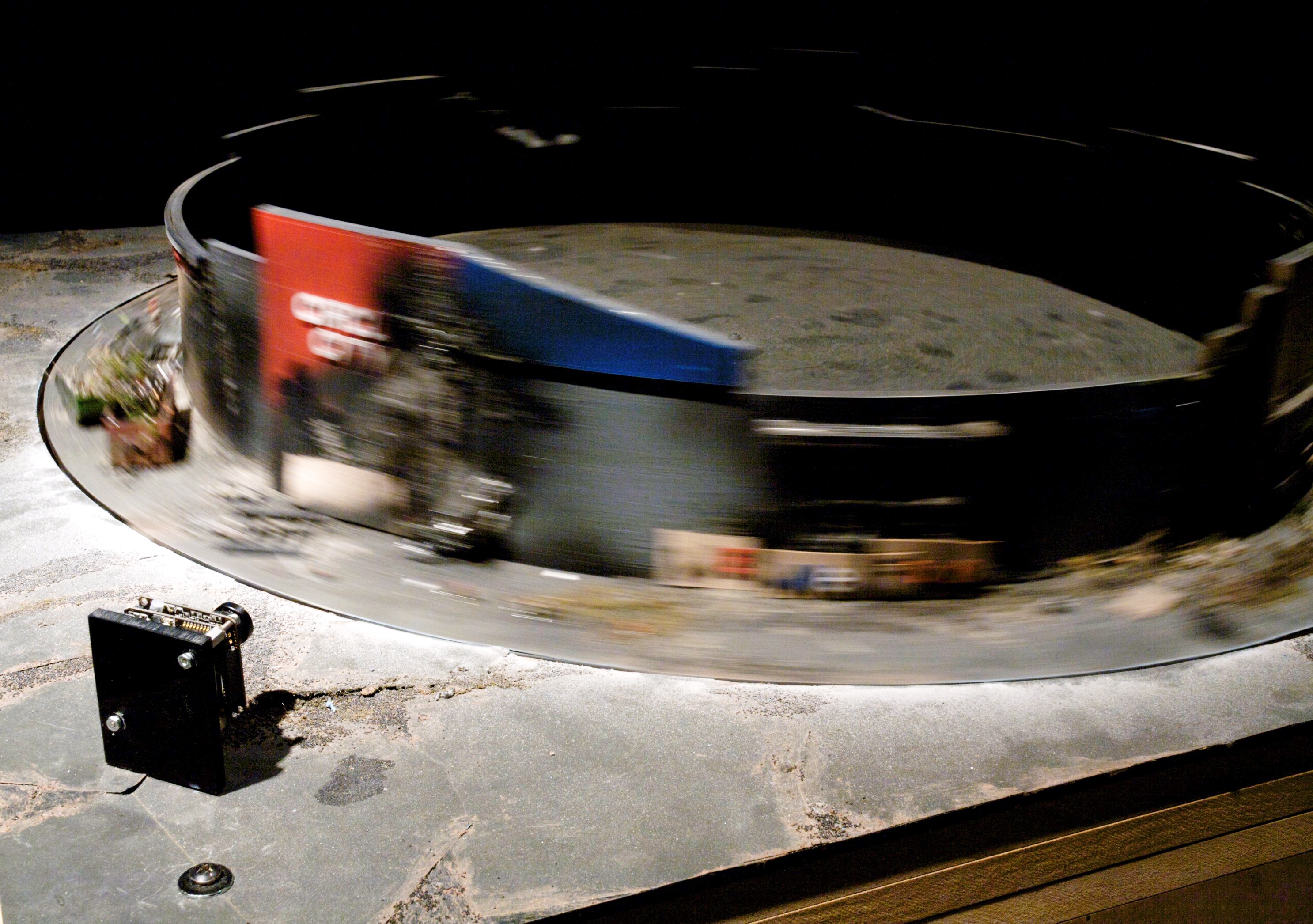
mixed media sculpture with cameras, motor, electronics and video output.
Courtesy of Postmasters Gallery and the Artist
"In the two Big Box sculptures, models of an American-style big box shopping mall are placed on a slowly rotating turntable. The clean, nearly featureless mall building facades have been modified. In one reality, a trash-filled wasteland, and in another an over-grown jungle. In the wasteland, zombies have made advances. In the jungle,
the mall has been converted to a biosphere. Single cameras films the scene, presenting it as a drive-by view on wall mounted monitors or projections." Lev Manovich
Jennifer and Kevin McCoy are media artists whose works extends from the moving image and software to drawing, painting, and installation. Their projects often seek to situate new technologies within our culture, using contemporary tools and questioning their impact both on the individual and on society. Early projects include
database sculptures of television clips filtered into categorical frameworks and diorama like miniature film sets activated by live cameras and software. In their work, technology serves as a mediator between the human and the world, and as an active force which not only shapes its material but reframes the entire project of what we choose to see. Recent work refigures mid century images of the American west with collaged databases of AI
generated landscape photography.
ign=center style='margin-bottom:12.0pt;text-align:center'>
software, computer, screen, programming Luka Frelih
Courtesy of the artist and Postmasters 5.0
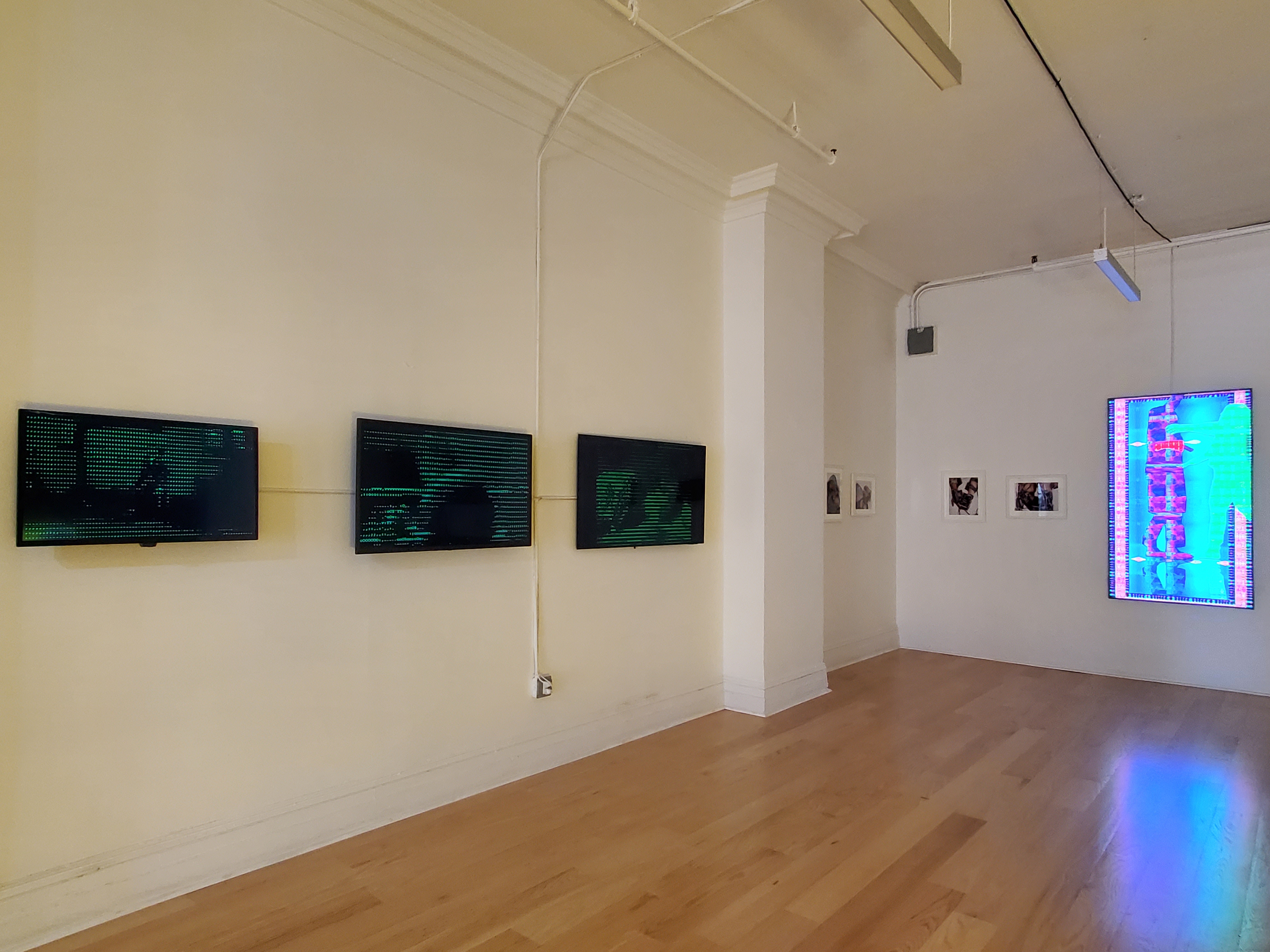
Influential, first-generation net artist Vuk ĆosiĆ presents three work, Raging Bull, 1999, Singing in the Rain, 1999, and Star Trek, 1998 a moving ASCII image where a sequence from the iconic TV series is converted into ASCII, the format he pioneered.
ĆosiĆ is a leading figure among the artists who first explored the creative possibilities of the World Wide Web in the mid-1990s. He is the co-founder of the influential mailing lists nettime, Syndicate, and 7-11, as well as of the Ljubljana Digital Media Lab. He is known for creating still and moving image artworks
with ASCII code, using a custom-made software he developed in 1996.
The history of ASCII code compresses a number of technological and conceptual developments which lead to (but I am sure will not stop at) a modern digital computers: cryptography, real-time communication, communication networks... By juxtaposing this code with the history of cinema, ĆosiĆ accomplishes what can be called an artistic compression: it brings together many key issues of computer culture and new media art together in one rich and elegant project.
4-channel Video with Audio.
Courtesy of the artist and TRANSFER
Image Credit: Ivan Zupanc © Eugster || Belgrade
Among Us, Among Others was commissioned by Onassis Stegi as part of "Plásmata: Bodies, Dreams, and Data" exhibition in 2022. The project approaches a plethos of bodies that emerge, move and rest - sometimes as a single collective body and sometimes as unique entities. These bodies are formed as diverse critters/
agents - mimicking human but also natural/organic/animal entities. These peculiar avatars resembling something between video-game characters and mythological creatures are making gestures, moving their bodies in a lethargic or ecstatic way, engaging into unexpected or banal motions and expressions - while synchronizing, abandoning or uniting with each other again and again, creating an uncanny choreography in which they are trying to identify their own selves. The viewers' bodies accordingly, approach and get mingled
with these 'moving sculptures' that almost antagonize them in scale, while at the same time are getting immersed, but also entangled with their presence and actions.
The 4-channel work is an immersive sound installation, which can be installed in a 4-channel pillar in which the viewer circulates around the work on 55-65" screens, or in a 4-channel circle surrounding the viewer on life-sized LED displays.
Computer, Video, Software, pedestal
Courtesy of Postmasters Gallery and the Artist
The Dress, the wind and me, 2024 was filmed during the pandemic. It was shot at the same Manhattan location as the original Marilyn Monroe scene with the artist himself assuming the role of Marilyn wearing the iconic white dress. The air blowing up Marilyn's dress is replaced by the computer fans affecting Damjanski's movements to keep control of the garment. The interdependency of URL and IRL and how they impact one another exposes yet another instance of creating of online personas and identities.
5-channel Animated GIF.
Courtesy of the artist and TRANSFER.
Petting Zoo: Demons Begone is a 5-channel animated GIF from Lorna Mills, expanding her 'Petting Zoo'
series. It captures 'petting' in all its manifestations: sometimes light, sometimes heavy, sometimes soothing, sometimes frenzied.
"I always consider myself working when I'm online," Mills says. For her, there's no distinction between mindless browsing and intent searches for specific material-you never know what you might find. She sources images from Reddit, Google+, Porn Fail, and the deep web, and takes clear delight in "internet filth"
but also gives careful attention to mundane imagery we might not normally think twice about. This multi-channel collage work is characteristic of her GIF-based installations. It layers looping animations of found imagery like adorable animals in unusual situations, comfort foods, and bizarre characters until the collective effect turns intangible, anxious, and outrageous.
Canadian artist, Lorna Mills has actively exhibited her work in both solo and group exhibitions since the early 1990's. Her practice has included obsessive Ilfochrome printing, obsessive painting, obsessive super 8 film &
video, and obsessive on-line animated GIFs incorporated into restrained off-line installation work.
Algorithmic Video Game and Custom Controller
Courtesy of the artist and TRANSFER
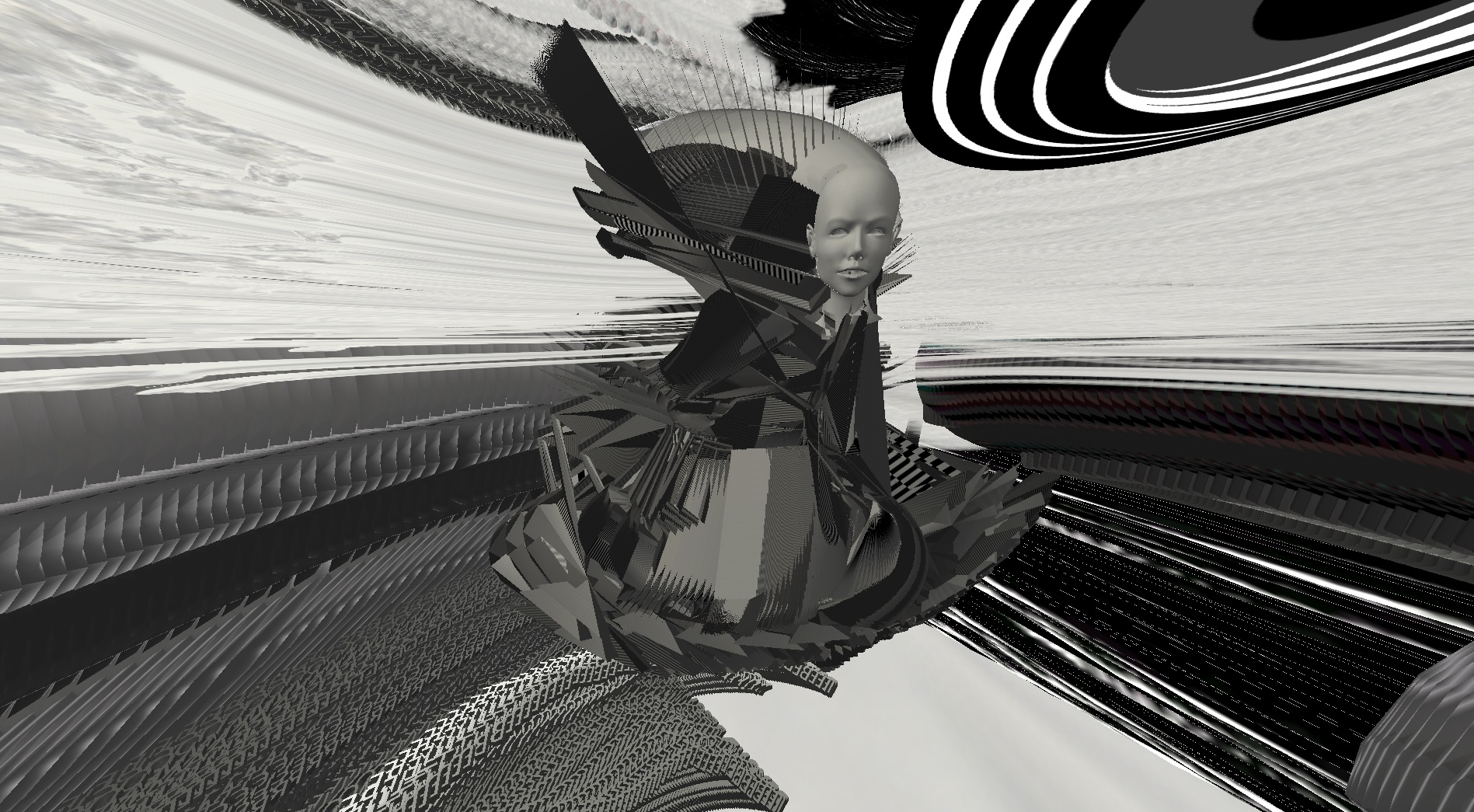
Xilitla is a little village in the Huasteca region of Mexico. Here, in the early 1940s, Sir Edward James - a poet known for his patronage of the surrealist art movement - started the construction of his own idyllic, surrealist pool garden, Las Pozas, in which he deconstructed the many forms and styles of functional architecture. In
the hands of Rosa Menkman, Xilitla has been transformed into a hallucinatory, futuristic 3D architectural environment consisting of moving images, laced with polygons and dysfunctional objects. Inside this algorithmic piece, a Janushead is used to navigate Menkman's digital dreamscape. Taking advantage of the tensions between gameplay and audiovisual art, this aesthetic experiment opens up a new, eerie poetic and
fantasmatic universe.
Xilitla exists as a free downloadable application, released in 2013 by the artist.
Rosa Menkman is a Dutch artist and theorist who focuses on visual artifacts created by accidents in both analogue and digital media. The visuals she makes result from glitches, compressions, feedback and other forms of noise. Although many people perceive these accidents as negative, Menkman emphasizes their positive consequences: these artifacts facilitate an important insight into the otherwise obscure world of media
resolutions.
single channel video.
Courtesy of Postmasters Gallery and the Artist
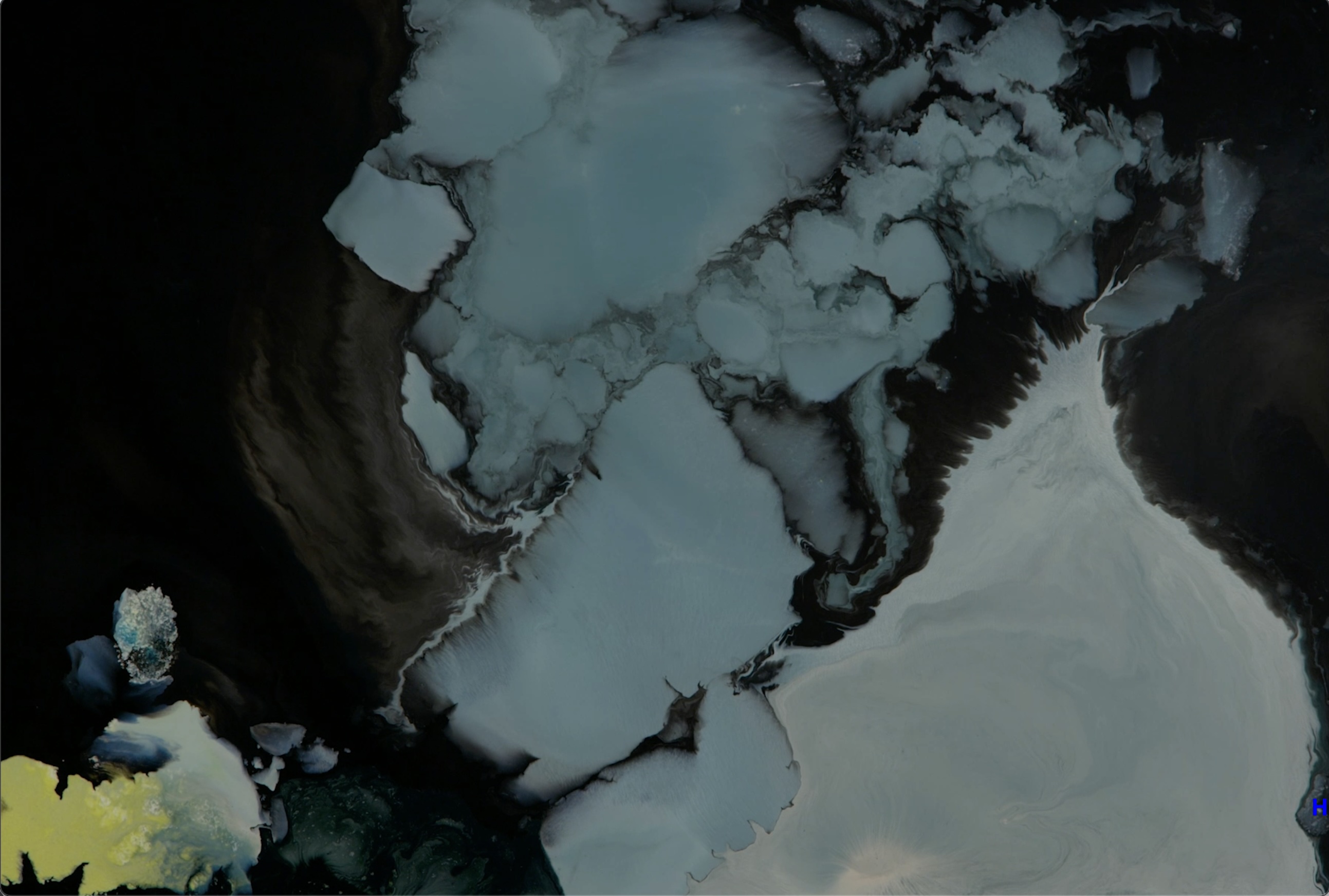
Marta Kucsora captured the intricate movement of paint layers in a pool set up in her studio, a stark departure from flawless AI-generated videos. "Beautiful Error" explores the unintended impact of seamlessly
integrated digital technologies, prompting a poetic journey. In a world where digital standards distort perception, the artwork urges us to appreciate the gracefully flawed nature of physical reality. Embracing imperfections becomes a symbol of resistance, encouraging us to disrupt the system as glitches. Known for her grandiose canvases, Kucsora's video installations seek to expand the traditional tools of
painting, breaking the constraints of the medium. The artist's experiment in combining moving image and sound provides an alternative to the aesthetic experience of the painterly processes that are differentiated but unrepeatable in terms of compositional formulation, which Kucsora also seeks to explore through more effective means of expression for contemporary visual thinking. The starting point of her video installations
is the same expendables (different paints, compounds and desiccants that influence their amalgamation)
that she utilizes in her paintings.
4k 3D animation with audio
Courtesy of the artist and Postmasters 5.0
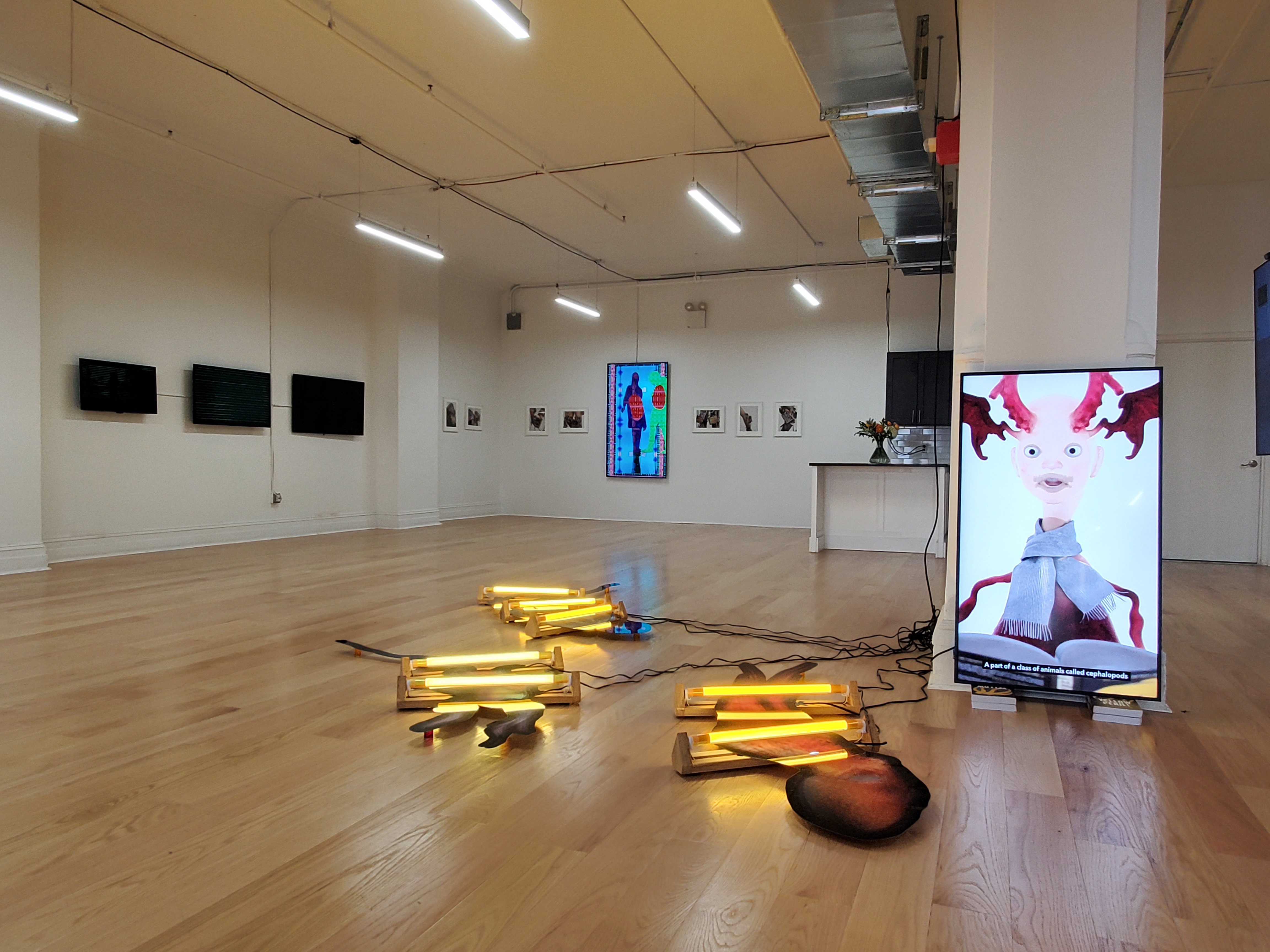
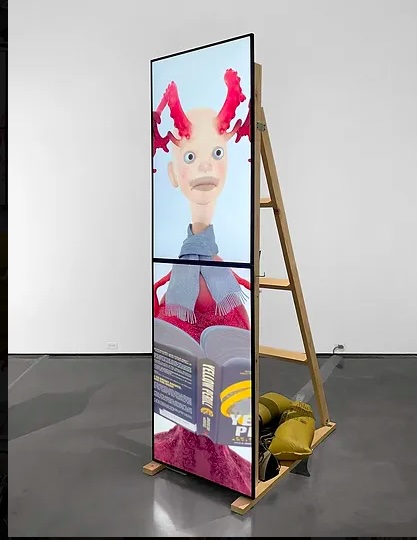
Intense yellow light is cast onto the prints of mysterious deep-sea invertebrates and a looping video animation placed among them. Pantheon of Octopi and The Levitating Perils delve into the genealogy of "Yellow Peril" rooted in a long tradition of Eurocentric representation of Asia as a threat to the West." A vicious octopus with
Fu-Manchu's head is an icon that consistently appears via images, documents, and texts. In the video Yellow Perilist anxieties are exposed. A creature with an octopus body and dragon heads levitates uncannily. It looks indifferent and whimsical rather than dangerous. Wang subverts the historically rigid racial symbol and the
stereotypes of "Asia" - a century-long fear that still exists: "Yellow to whom and Peril to whom?"
Frank Wang Yefeng works across various media, including 3D animation, video installation, sculpture, and writing. His migratory experience at a young age drives him to explore his reality as a multicultural individual.
The estrangement of the origin and the absence of home turn "in-betweenness" into his constant dwelling.
Ambivalent characters play essential roles in Yefeng's works, where he explores the transmission of affect and the in-between states of nomadic subjects in both virtual and physical realms.
.jpg)
oil on canvas
Courtesy of Postmasters Gallery and the Artist
Gretchen Andrew manipulates systems of power with art, glitter and code. She is best known for her playful hacks on major art world and political institutions, including Frieze, The Whitney Biennial Artform, The Turner Prize, and The Next American President. In these digital performances she reimagines reality with art and desire.
Facetune Portraits, 2024 are Gretchen Andrew's new series of works that can be described as "Canvas Battles with AI & Algorithms" Facetuning and Bodytuning are AI-enabled, algorithmically driven ways to make yourself look more appealing on social media. Such apps and filters are widely used on Instagram, TikTok, and even via Zoom's "Touch up my appearance" feature. Andrew uses custom robotics to physically apply popular AI algorithms onto oil paintings. The portraits (oil prints on canvas) are defaced
with a paint scrubbing plotter that applies "beautifying" filters to the image. There is a tension between who you are and who today's society says you should be. These are portraits of that tension. What happens when the digital manipulation of Face Tuning collides with the physical world?
Interactive Face Filter Installation, dimensions variable.
Courtesy of the artist and TRANSFER
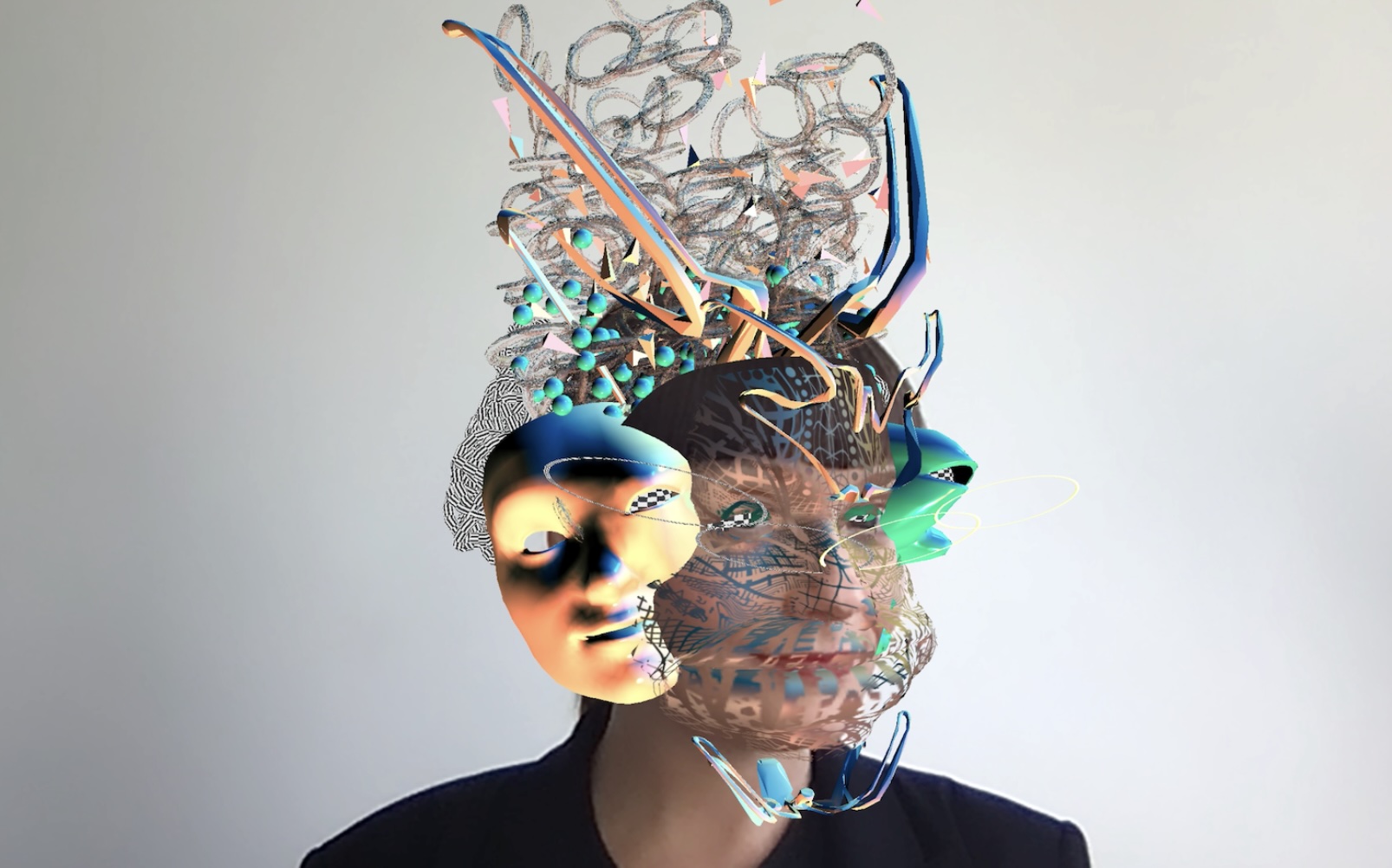
In her multi-layered face filters, Huntrezz Janos weaves an augmented reality mythology of the self. Drawing
upon a long lineage of masks used as symbolic narrative devices, Huntrezz's filters introduce fantastic and
impossible characters that represent different real, imagined, and daydreamed happenings in her life. Huntrezz explores the fantasies of a Black, Non-Binary artist grappling with her lived realities of systemic violence and exclusion. The interactive face filters are available for acquisition as Unique Installations (1 + 1AP) which are experienced in both physical and online encounters. The works are delivered as Meta Spark AR files, and viewable through instagram or via Meta Spark AR Player on PC and MAC computers.
Janos is an Afro-Hungarian transcorporeal artist known for mediating her inquiry into the layered nature of identity through simulation, augmentation and world-building. Janos works across a variety of media including installation, painting, sculpture, performance and writing-but her most prolific and well-known works are 3D graphics, animation, and augmented and virtual realities. In her digital works, Janos challenges preconceptions surrounding identity, gender, community and social infrastructure.
..........................................................................................................
Rebranded as Postmasters 5.0, we find locations to fit a particular exhibition or event in New York City and beyond.
In the course of almost forty years, Postmasters continues to represent and exhibit young and established artists who work across a range of mediums and formats including painting, sculpture, photography, video, installation, digital art and NFTs. The - now historic - exhibition "Can You Digit?" in 1996 marked the gallery's ongoing engagement with digital art. With strong emphasis on innovative practices Postmasters actively seeks new forms of creative expression to show in the context of traditional media. The artworks are largely content oriented, conceptually based and - most importantly - reflective of our time.
Postmasters Gallery archives have recently been donated to the Smithsonian. Extensive records of all exhibitions since 1999 are available online at www.postmastersart.com
TRANSFER exhibits virtual worlds and simulation in contemporary art, and maintains a decentralized Data Trust. Founded by Kelani Nichole in 2013 in Brooklyn NY, TRANSFER's mission is to support artists examining the social, cultural and political implications of emerging technology. Director Wade Wallerstein joined TRANSFER in 2019 when the gallery opened in Los Angeles, California. TRANSFER relocated to Miami, Florida in 2021.
TRANSFER Data Trust is an artist-owned archive and not-for-profit cooperative trust, established in 2023 at the gallery's 10 year anniversary with fiscal sponsorship from Gray Area. The emerging model is an open prototype for resilient cultural infrastructure that advances data sovereignty, digital equity and promotes long-term care of media art. The Data Trust is supported by Knight Foundation's Art + Tech Expansion Fund, Filecoin Foundation for the Decentralized Web, Filecoin Foundation, and NYU Tandon School of Engineering's Integrated Design and Media Program.
TRANSFER's exhibitions and Data Trust are available online at http://TRANSFER.art
..........................................................................................................
..........................................................................................................